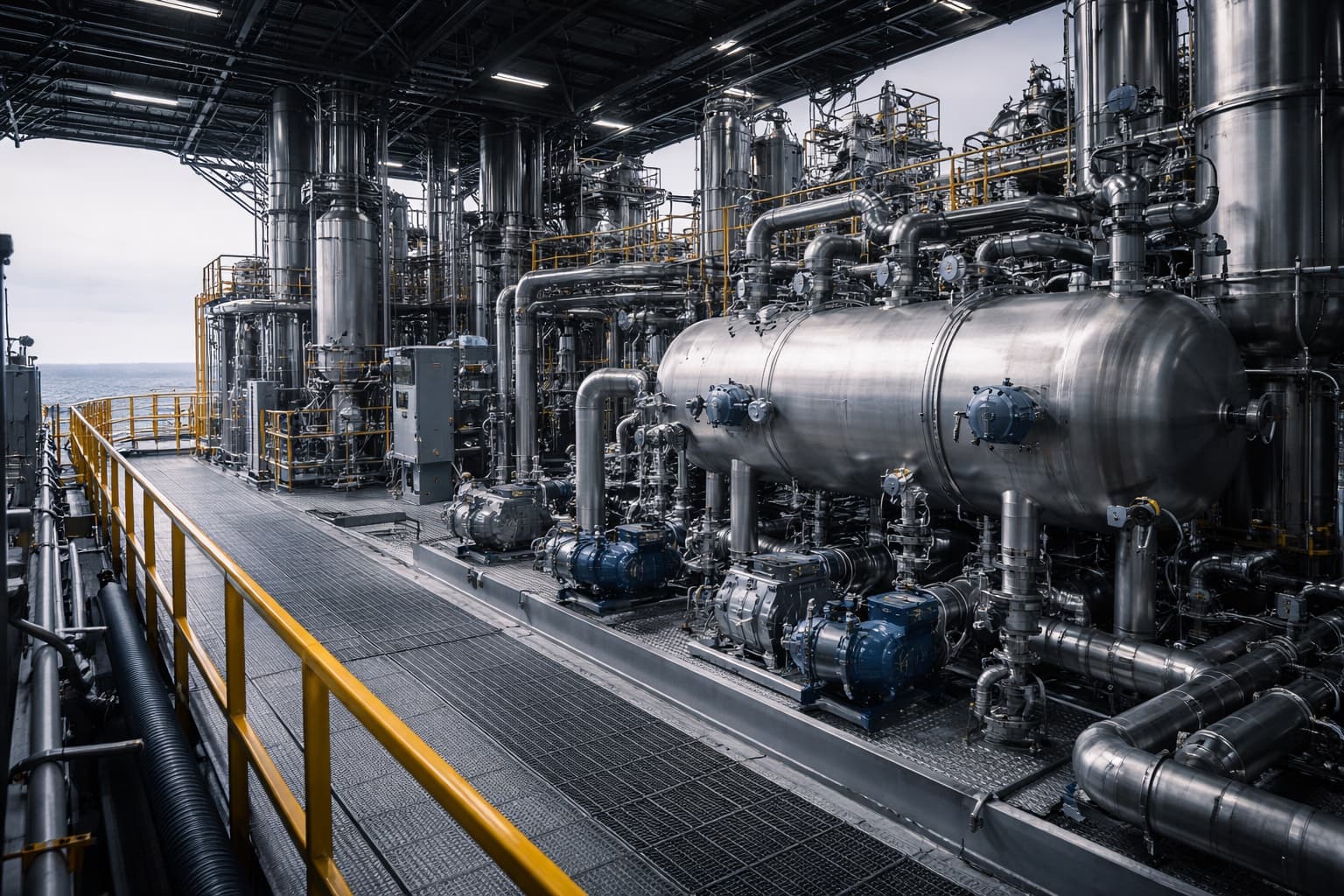
Context fit for environments where delivery and operating risk are inseparable.
ASTOR works in sectors where technical literacy, operational realism, and executive governance all need to hold at the same time.
Selective, senior, and built for operating contexts where the next decision carries real consequence.
Clarify context, sharpen the control point, and keep executive and site-level logic connected.
ASTOR is built for complex energy and industrial environments, not broad-market consulting.
Sector coverage is framed around environments where asset integrity, readiness, execution control, and continuity decisions have visible consequence.
Each sector is defined by its operating constraints, not by generic industry labels.
The sector cards below connect context, risk patterns, and the service logic that matters most in each environment.
Offshore oil and gas
Execution environments where delivery risk, asset behaviour, and continuity decisions are all visible at once.
High-consequence offshore operations with layered interfaces across sponsors, operations, engineering, and contractors.
Risk patterns
- • Interface friction between delivery teams, operators, and specialist contractors.
- • Continuity and integrity exposure when degraded conditions persist without a clear operating narrative.
- • Decision lag caused by incomplete visibility across offshore constraints and stakeholder pressure.
Capability focus
FPSO and floating production
Complex floating-production environments where startup readiness, offshore integration, and continuity risk need disciplined leadership attention.
Floating production systems with handover, commissioning, and offshore interface pressure concentrated into narrow decision windows.
Risk patterns
- • Startup confidence is undermined by weak systems completion and handover discipline.
- • Owner, EPC, vendor, and operator interfaces create blind spots at the point where readiness must be clear.
- • Offshore constraints magnify the cost of ambiguous decisions or recovery moves.
Capability focus
Energy infrastructure and gas compression
Capital and operating environments where rotating equipment, controls, and systems integration must be governed against real delivery and continuity constraints.
Compression, power, and infrastructure programmes where technical depth and commercial governance both matter to the next decision.
Risk patterns
- • Schedule or readiness pressure spreads across equipment, controls, and package interfaces.
- • Technical decisions with commercial consequence are being made without a stable integrated view.
- • Reliability and continuity risk rise when operating constraints are not connected to programme control.
Capability focus
Power and industrial assets
Industrial asset portfolios where uptime, integrity, and operating discipline need senior intervention without generic transformation language.
Asset-intensive industrial settings where continuity, reliability, and maintenance decisions must remain commercially grounded.
Risk patterns
- • Asset-performance degradation is visible, but leadership priorities are not yet aligned to consequence.
- • Improvement programmes are active without a clear linkage to risk reduction and continuity.
- • Operational teams need technically literate support that still reads as executive-grade guidance.
Capability focus
Brownfield and high-risk operating environments
Live-asset and transition settings where change must be governed carefully because ambiguity has immediate operational consequence.
Brownfield, live-operations, or recovery contexts where intervention has to respect active risk, constrained windows, and existing operating pressure.
Risk patterns
- • Recovery work competes with continuity obligations and stakeholder pressure.
- • Live-asset constraints expose weak governance cadence quickly.
- • Intervention sequencing becomes fragile when operating context is simplified too aggressively.
Capability focus
A compact view of the technical landscape ASTOR can speak to with credibility.
Technical breadth is shown here as reusable taxonomy, not as disconnected capability claims.
The same failure patterns reappear across sectors in different forms.
ASTOR is most useful where these patterns have become operationally material and leaders need a more disciplined way to govern the response.
• Interface complexity that hides the true control point.
• Startup or handover pressure that outruns readiness visibility.
• Contractor or package drift that erodes sponsor confidence.
• Reliability or integrity exposure that is no longer being translated into clear priorities.
• Brownfield and live-asset constraints that narrow intervention options quickly.
Sector relevance maps directly back to ASTOR’s core service architecture.
The service surface is intentionally small. Sector fit determines which pillar becomes primary, not whether ASTOR invents a new service line.
Project execution advisory
Restore delivery control where interface friction, schedule pressure, and commercial exposure are starting to compound across complex programmes.
Commissioning & start-up support
Strengthen systems completion, handover logic, and operational readiness before startup risk becomes visible in the field or the boardroom.
Asset recovery & turnaround
Re-establish control when projects or assets have drifted, recovery options are narrowing, and decision quality needs to improve quickly.
Use the sectors page to confirm context fit, then move into the services and contact surfaces.
If the environment and pressure pattern are already clear, ASTOR should be engaged through direct consultation rather than generic sector exploration.