
Performance pressure becomes visible.
Failures, emergency work and backlog pressure increase activity without improving leadership confidence.
Reliability problems in live energy operations rarely sit inside maintenance alone. They usually emerge across work management, spares, CMMS quality, planning discipline, equipment condition, integrity exposure and operating pressure. ASTOR converts those signals into a practical consequence frame that leadership can act on.
Indicative service showcase. Results depend on asset condition, available evidence, mandate scope and implementation discipline.
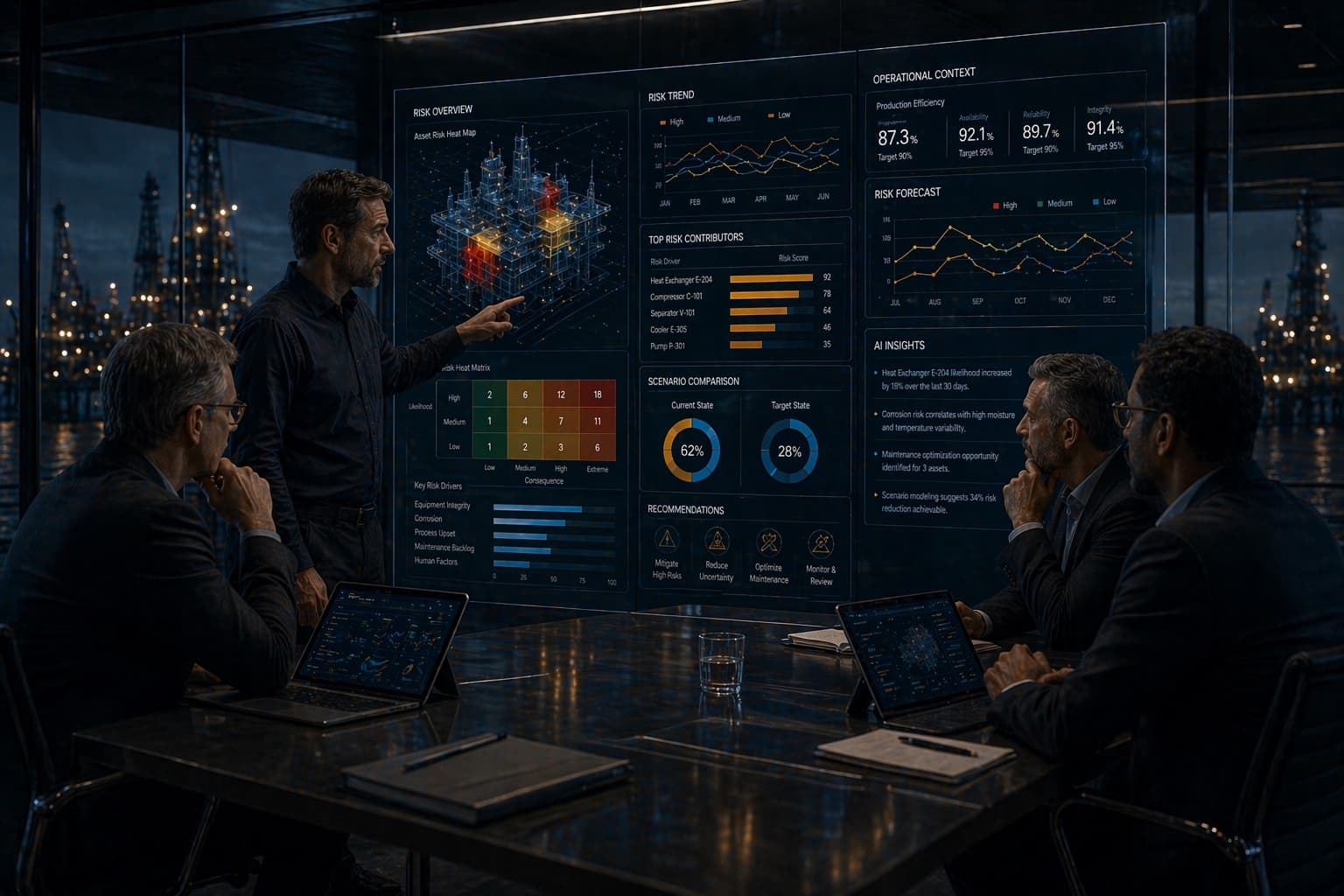
Comparable operations accountability evidence.
Efficiency improvement achieved in comparable accountability.
Assessment route coverage across maintenance and reliability control domains.
In the anonymized case behind this showcase, the visible symptoms were recurring equipment failures, high emergency work, incomplete work history, weak prioritization, material-readiness constraints and unclear linkage between reliability, maintenance and operational consequence. The issue was not a single failure mode. It was a control-system problem.
Failures, emergency work and backlog pressure increase activity without improving leadership confidence.
Assessment evidence, interviews and field validation are scored against control domains and ranked by risk.
Critical systems, CMMS, materials and governance workstreams move through a short-cycle leadership cadence.
Recurring failures, emergency work and backlog pressure create visible urgency but not necessarily the right priorities.
Incomplete work history, inconsistent asset data and weak failure coding reduce decision quality.
Spares, preservation, procurement and logistics issues can turn planned work into repeated execution delays.
PM/PdM, RCA, RAM/FMECA and risk-based prioritization must operate as one decision rhythm.
ASTOR's diagnostic model combines document review, stakeholder interviews, site or field validation, maturity scoring, Pareto analysis, causal-tree logic and risk classification. The output is not a generic findings list. It is a ranked recovery roadmap.
Maintenance data, incident records, backlog, procedures, spares and critical systems.
Confirm what can be trusted.
Interviews, operating-context checks and discipline-owner review.
Separate paper compliance from field condition.
Maintenance, reliability, CMMS, materials, planning and governance domains.
Locate the control gaps that drive consequence.
Pareto, causal-tree logic, risk classification and bad-actor review.
Move from findings to intervention choices.
Workstreams, execution constraints, shutdown dependency and leadership cadence.
Make the next decision executable.
Incomplete work history and weak failure coding.
Priority criteria, work-pack quality and schedule adherence need tighter control.
BOM quality, spares availability and procurement constraints delay execution.
RCA, RAM/FMECA and PM/PdM routines need one consequence frame.
Bad actors require ranked stabilization before activity increases further.
Recurring equipment failures and emergency work concentration.
Spares, preservation and procurement delays affecting planned work.
Incomplete asset data and inconsistent failure coding.
Weak prioritization, handoffs and executive cadence.
A reliability assessment creates value only when it becomes an executable recovery sequence. ASTOR structures the implementation through focused workstreams.
Bad actors, risk ranking, execution constraints and work-pack definition.
Work-order flow, priority criteria, backlog control, equipment history and planning discipline.
BOM quality, spares availability, preservation, procurement and logistics readiness.
RAM/FMECA, RCA, PM/PdM strategy, KPI logic and executive review cadence.
Scope frozen
Materials checked
Work pack ready
Executive review
The commercial value is not the assessment itself. It is the faster path to defensible intervention decisions: what must be executed, what can wait, what should be funded, what requires shutdown access and what should be escalated before uptime loss compounds.
Timelines are indicative service horizons, not committed outcomes. Results depend on evidence quality, access, mandate scope and implementation discipline.
Presented as comparable operations accountability evidence.
Presented as comparable operations accountability evidence.
Actual outcomes depend on asset condition, available evidence, mandate scope and implementation discipline.
Complete the form to receive ASTOR's Maintenance & Reliability Gap Assessment brief and qualify whether a diagnostic review is appropriate for your current operating pressure.